Brooklyn
9,775High collision volume. Atlantic Avenue, dense intersections, commercial traffic, pedestrians, and cyclists can all affect evidence.
Free 24/7 Consultation: No Fee Unless We Win
914-559-5834
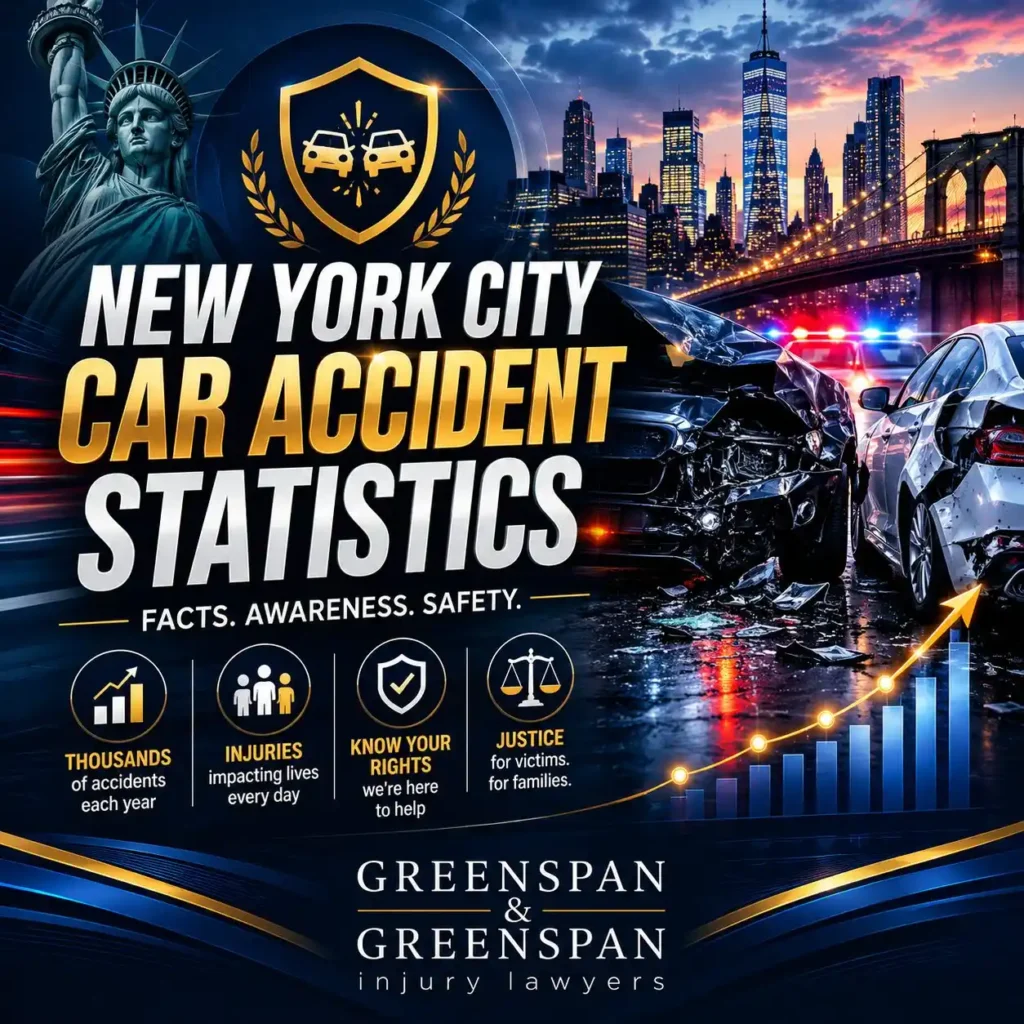
Every day, millions of people navigate New York City by car, taxi, rideshare, and commercial vehicle. New York City car accident hotspots exist in every borough, at intersections where poor design, driver negligence, and urban congestion converge.
New York City car accident statistics tell a sobering story: according to NYPD TrafficStat data, in the first 5 months of 2026 alone, the city recorded 30,179 collisions, 12,241 injuries, and 70 fatalities.
If you or a family member suffered an injury in a crash anywhere in New York City, the Bronx, Yonkers, White Plains, or Westchester County, Greenspan & Greenspan Injury Lawyers is ready to help. With over six decades of experience fighting for injury victims, our firm offers free consultations and works on a contingency fee basis; you pay nothing unless your case succeeds.
If you were hurt in a New York City crash, the location, crash pattern, traffic signal history, camera footage, NYPD report, DOT records, and driver behavior may all help prove liability and protect your claim.
The article shows that crash risk is not the same across every borough or nearby corridor. Use this section to connect the crash location with the type of evidence that may matter.
High collision volume. Atlantic Avenue, dense intersections, commercial traffic, pedestrians, and cyclists can all affect evidence.
Queens Boulevard, Jamaica Avenue, heavy arterial traffic, turning crashes, and failure-to-yield disputes may matter.
The Bronx has elevated serious injury risk. Bruckner Boulevard, East 138th Street, and highway corridors may require fast evidence preservation.
Central Park Avenue and South Broadway combine commuter traffic, retail traffic, pedestrians, and turning movements.
I-287, Route 119, Route 100, Mamaroneck Avenue, Central Avenue, and North Broadway create commuter crash risks.
If a location has prior crashes, signal issues, bad sight lines, faded markings, or known safety complaints, that history may help show the danger was foreseeable.
A crash at a known hotspot is only useful if the right records are preserved. Open each evidence type to see what may help connect the crash, location, driver conduct, and injuries.
Traffic cameras, MTA bus cameras, dashcams, rideshare cameras, and nearby business footage may show vehicle speed, signal status, lane changes, turns, and driver behavior.
Prior crash history, complaints, maintenance records, signal timing, lane markings, and police reports may help prove that a dangerous condition was known before your crash.
Vehicle damage, black-box data, phone records, commercial delivery logs, rideshare app activity, and witness statements can help prove distraction, speeding, failure to yield, or unsafe following distance.
Medical records help show whether the injuries meet New York’s serious injury threshold and whether pain, limitations, surgery, or fractures,may permit you to pursue noneconomic damages.
Evidence is not automatically preserved. The sooner an attorney acts, the better the chance of securing records before they disappear.
Statistics show where crashes happen. The law decides what proof is needed to recover compensation. These are the legal pressure points injured people should understand early.
New York No-Fault may cover medical bills and lost wages up to policy limits, but it does not pay pain and suffering.
To pursue pain and suffering, the injury may need to meet New York’s serious injury threshold, such as fracture, significant limitation, or permanent impairment.
If the insurer blames you, your compensation can be reduced by your fault percentage. Evidence helps counter unfair blame.
If New York City or another government entity may be responsible, a Notice of Claim may be required within 90 days.
Many New York personal injury lawsuits must be filed within three years, but shorter deadlines can apply in government-related claims.
Prior crash history, maintenance issues, and known dangerous conditions may help expand the case beyond the at-fault driver.
That question should be checked early. Missing a government notice deadline can permanently close part of the claim.
From NYC intersections to Bronx corridors, Yonkers roads, and White Plains commuter routes, Greenspan & Greenspan uses crash evidence, agency records, medical proof, and insurance strategy to build strong injury claims.
Past results do not guarantee a similar outcome. Every case depends on the facts, injuries, liability, insurance coverage, evidence, deadlines, and other case-specific issues.
Brooklyn and Queens consistently lead the city in collision volume. Through the first 5 months of 2026, Brooklyn recorded 9,775 collisions and 4,015 injuries, while Queens followed with 8,554 collisions and 3,472 injuries. Together, those two boroughs account for the majority of all crash-related injuries citywide. The reason is consistent: New York never designed arterials like Atlantic Avenue, Queens Boulevard, and Jamaica Avenue to handle the volume of vehicles and pedestrians they carry today.
The Bronx logged 5,119 collisions and 2,249 injuries in the first five months of 2026, and carries a serious injury rate 20 to 23% above the citywide average. East 138th Street holds the highest fatality rate per mile in New York City, with 12 people killed on a 1.5-mile stretch between 2014 and 2023. Transportation Alternatives identifies the intersection of Bruckner Boulevard and St. Ann’s Avenue as one of the most dangerous in the borough.
Yonkers carries the dual burden of Westchester commuter traffic and overflow from New York City. Central Park Avenue (Route 9A), the city’s main commercial corridor, is densely populated with retail, delivery vehicles, and residential cross-traffic, creating conditions that produce rear-end and turning-movement crashes. South Broadway, which flows directly from upper Manhattan through Yonkers’ most densely populated neighborhoods, carries heavy northbound and southbound traffic, with frequent conflicts between through drivers and local pedestrians.
Federal data from the National Highway Traffic Safety Administration puts those local dangers in a broader context. Westchester County recorded 42 traffic fatalities in 2024, with single-vehicle crashes accounting for 34 of those deaths, up from 21 in 2022. Roadway departures claimed 23 lives, pedestrian fatalities rose to 13, and intersection-related deaths climbed to 11. Wider roads and higher speed limits produce a different kind of danger than city streets, but the body count tells the same story.
White Plains, the county seat of Westchester, sits at the convergence of Interstate 287, Route 119, and Route 100, with thousands of vehicles traveling on the I-287 corridor daily. Between 2014 and 2023, the city recorded 3,255 crashes, 353 serious injuries, and 12 fatalities. Its 2024 Vision Zero speed limit reduction exempted 10 high-volume roads, including Mamaroneck Avenue, Central Avenue, and North Broadway, the very corridors where the most serious crashes in White Plains continue to occur today.
According to 2025 NYPD contributing factor data, the three leading causes of crashes in New York City were:
These numbers point to a single, uncomfortable truth: most crashes are not accidents. They are the predictable result of the choices drivers make behind the wheel.
Red-light running tells a similar story of deteriorating behavior. According to the NYC Department of Transportation (DOT) Red Light Camera Program Review, 29 people were killed in red-light running crashes in 2023, more than double the annual average of the previous decade. Since 2020, daily red-light camera violations have increased 54%, a trend the DOT directly attributes to the breakdown in driving culture that followed the pandemic.
Another force reshaping New York’s roads is the explosion of commercial delivery traffic. Amazon vans, food delivery trucks, and large box trucks now compete for the same lane space as passenger vehicles, cyclists, and pedestrians, and their drivers operate under relentless time pressure. Double-parking, sudden stops, and blind-spot collisions have all increased as a result. When a fully loaded commercial truck strikes a passenger vehicle, the mass disparity almost always results in severe or catastrophic injuries to the occupants of the smaller vehicle.
Timing plays a significant role in crash frequency and severity across the city:
While motorists make up a significant portion of traffic injuries, vulnerable road users bear the brunt of fatal crashes.
New York’s No-Fault Insurance Law requires injured persons to file claims with their own insurer first, regardless of fault. No-Fault Personal Injury Protection (PIP) covers medical expenses and lost wages up to $50,000, but pays nothing for pain and suffering. To pursue those damages, an injured person must satisfy the Serious Injury Threshold Law, proving a serious injury such as:
New York’s comparative negligence rule means that partial fault does not necessarily bar a claim. A jury finding that an injured person was 20% responsible reduces their recovery by 20%, not to zero. Violations of the Vehicle and Traffic Law, such as speeding, red-light running, and distracted driving, serve as direct evidence of the at-fault driver’s negligence and are among the most effective tools for countering an insurance company’s attempts to shift blame onto the victim.
When a crash occurs at a documented New York City car accident hotspot, that history is not background information. It is evidence.
Prior crashes at the same location prove the danger was foreseeable and serve as the legal foundation for negligence claims against government entities. DOT maintenance records reveal whether the city had prior notice of a defective signal, faded lane markings, or an obstructed sight line and failed to act. Where road design or maintenance contributed to the crash, those records extend the claim beyond the at-fault driver and into municipal liability.
Identifying whether you have a claim against the city is one of the most consequential determinations an attorney makes early in a case. A personal injury claim typically carries a three-year statute of limitations against an at-fault driver. But a claim against the City of New York requires a Notice of Claim filed within 90 days of the accident, before you can file suit. If you miss the deadline, the claim against the city is permanently closed.
Physical evidence from the crash site reinforces everything the records show. Red-light camera footage and MTA bus cameras capture the collision from angles no other source provides. This footage can show:
None of this evidence is automatically preserved. Camera footage is routinely overwritten within days. NYPD reports and DOT records require formal demands. An attorney who knows which agencies hold which records and how quickly to move is essential.
New York City car accident hotspots are not random. They are the product of documented patterns, known dangers, and institutional failures that government agencies have measured, mapped, and in too many cases, ignored.
At Greenspan & Greenspan Injury Lawyers, we know these roads, these intersections, and these agencies, and we use that knowledge to build cases that insurance companies cannot dismiss. Our attorneys have spent more than six decades turning New York City car accident statistics into results for injured New Yorkers across all five boroughs, Yonkers, White Plains, and Westchester County. We are fully bilingual in English and Spanish, work exclusively on contingency, and charge nothing unless your case succeeds.
Contact our firm today for a free consultation.
Car accidents are a daily occurrence. The city averages between 96,000 and 98,000 motor vehicle collisions every year, meaning there are roughly 260 crashes every single day across the five boroughs.
Brooklyn consistently records the highest total number of collisions and injuries, followed closely by Queens. High-traffic corridors like Queens Boulevard, Atlantic Avenue, and the Belt Parkway are frequent hotspots for severe accidents.
They are currently going down. After plateauing at over 250 deaths per year from 2021 to 2024, NYC traffic fatalities dropped significantly to 205 in 2025—the lowest number in the city’s recorded history.
Driver inattention and distraction is the undisputed leading cause of crashes in NYC, followed by failure to yield the right-of-way, following too closely, and unsafe speeds.
Legal References Used to Inform This Page
To ensure the accuracy and clarity of this page, we referenced official legal and other resources during the content development process: