

You have the green light crossing Queens Boulevard when a car running the red catches your driver’s door before you ever see it coming. Your car spins into the next lane and stalls out against the median, and you sit there for a moment before you trust your legs enough to get out. When the officer arrives, the other driver already has an answer ready: the light was theirs.
Greenspan & Greenspan Injury Lawyers know how it feels when the other driver was careless, and the police report still points the finger at you. We also know that a T-bone crash leaves almost nothing between the impact and the person inside. We are here to guide you and advocate for you through the steps ahead.
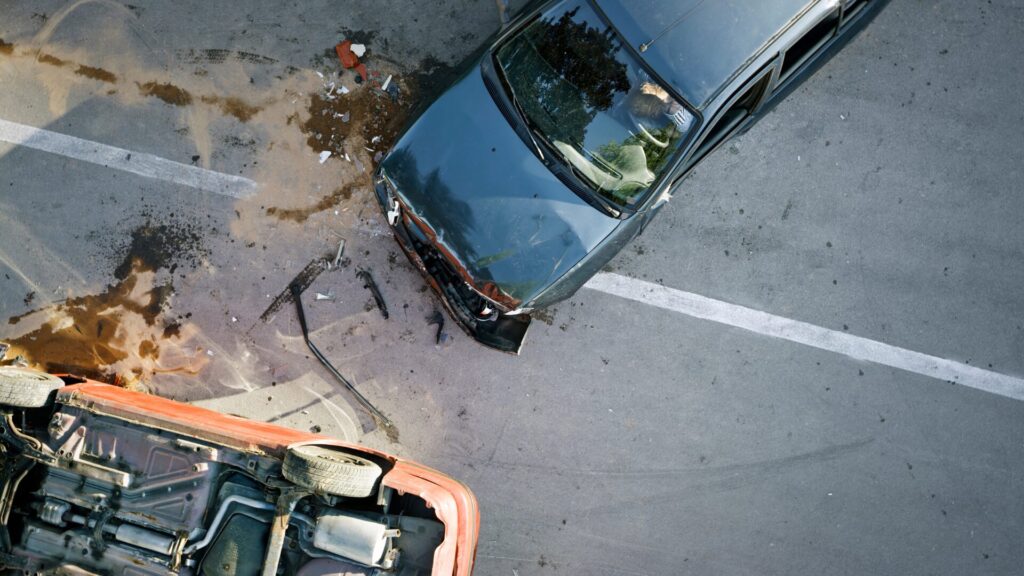
Do You Need a New York T-Bone Accident Lawyer?
A car accident lawyer in New York can help you when a side-impact crash turns into a dispute over who had the right of way. These crashes rarely settle quickly, since both drivers often insist the light or the right of way belonged to them, and an insurance company can use that disagreement as a reason to delay payment or offer far less than your injuries actually cost. If you are facing a stalled claim or a lowball offer after a T-bone crash, a lawyer can help build the evidence needed to establish what actually happened at that intersection.
What Causes T-Bone Accidents?
T-bone crashes happen when one vehicle strikes the side of another, almost always at an intersection, and they often stem from one of a few of the following recurring causes:
- Running a red light or stop sign. A driver who fails to stop or misjudges a yellow light can cross directly into the path of a vehicle with the right of way.
- Failing to yield when turning left. A driver turning left across oncoming traffic who misjudges the gap can be struck broadside by an oncoming vehicle.
- Distracted driving. A driver looking at a phone or otherwise not paying attention can miss a red light, a stop sign, or an oncoming vehicle entirely.
- Speeding. A driver moving too fast for an intersection has less time to stop or react, and a car exceeding the speed limit is far more likely to enter an intersection unsafely.
- A malfunctioning traffic signal. When a traffic light is out of service or stuck, New York law requires drivers to treat the intersection like a stop-sign-controlled intersection, a rule many drivers do not know and often fail to follow.
Because T-bone crashes typically involve two vehicles approaching from different directions, sorting out exactly what each driver did in the seconds before impact is central to determining fault.
How Is Fault Determined in a T-Bone Accident?
New York law sets out specific right-of-way rules for intersections, and these rules typically decide who was at fault in a T-bone crash:
- At an intersection without signs or signals. When two vehicles enter an uncontrolled intersection from different roads at roughly the same time, the driver on the left must yield to the driver on the right. A driver who has already entered the intersection generally has the right of way over a driver just approaching it.
- At a stop sign or yield sign. A driver approaching a stop sign must come to a complete stop and then yield to any vehicle already in the intersection or approaching so closely that it presents an immediate hazard. A driver who rolls through a stop sign or misjudges how close oncoming traffic actually is bears responsibility for a resulting collision.
- At a traffic signal. A driver facing a green light generally has the right of way. However, that right-of-way is not absolute, since a driver turning left or right on green must still yield to vehicles and pedestrians already lawfully in the intersection, and a driver who enters on red or turns without yielding is generally at fault.
Sorting out which of these rules applies, and which driver actually violated it, is often the deciding factor in who bears responsibility for a T-bone crash.
Can You Still Recover Compensation If You Were Partially at Fault?
New York allows an injured person to recover compensation even if they were partially at fault, with their own percentage of fault reducing the amount recovered. However, since May 2026, New York bars recovery entirely in motor vehicle injury cases if the injured person’s fault exceeds the combined fault of everyone they are suing.
This becomes especially relevant in T-bone cases, since an insurance adjuster investigating the crash will often look beyond who had the right of way and examine whether the injured driver was speeding, distracted, or otherwise contributed to the severity of the collision, even when the injured driver had the legal right of way. Having the right of way does not eliminate the duty to drive reasonably, and an adjuster who finds evidence of speeding or inattention on the injured driver’s part may use it to reduce the claim’s value, or, in some cases, eliminate it.
What Injuries Are Common in T-Bone Accidents?
Side-impact crashes tend to produce especially severe injuries, largely because a vehicle’s doors and side panels offer far less protection than its front or rear crumple zones. Some of the most common injuries include:
- Head and traumatic brain injuries. The side of a vehicle absorbs far less impact energy than the front, which can translate directly into forceful head trauma for the person seated closest to the collision.
- Chest and rib injuries. The force of a side impact often pushes directly into the torso, causing fractured ribs or internal injuries.
- Hip and pelvic injuries. The door and side panel sit close to a seated occupant’s hip and pelvis, making fractures in this area common in T-bone crashes.
- Spinal injuries. The sideways force of impact can twist the spine in ways front or rear collisions typically do not, increasing the risk of serious spinal injury.
The severity of these injuries often depends heavily on where a person was sitting, since the side closest to the point of impact typically absorbs the most force.
Does It Matter Whether You Were on the Near Side or Far Side of the Impact?
Yes. In vehicle safety research, a near-side impact is a crash where the striking vehicle hits the side of the car closest to the occupant, such as a driver struck on the driver’s side. A far-side impact is a crash in which the occupant is seated on the side of the vehicle opposite the point of impact, such as a passenger on the side away from the collision.
Near-side occupants typically absorb the most direct force and face a higher risk of severe injury, since there is very little distance between the point of impact and their body. Far-side occupants are not necessarily safe from serious harm, though: the force of a severe T-bone crash can throw an unbelted or improperly restrained occupant across the vehicle toward the point of impact, sometimes resulting in injuries similar to those on the near side.
Seating position at the time of the crash is one more detail worth documenting carefully, since it can meaningfully affect both the injuries a person sustained and how a case explains why those injuries occurred.
How Do New York’s No-Fault Rules Apply to a T-Bone Accident?
New York requires drivers to carry No-Fault insurance, which pays a portion of medical bills and lost income after a crash regardless of fault. But No-Fault benefits do not cover pain and suffering, and they often fall short of the true cost of a severe T-bone accident injury.
To pursue compensation beyond No-Fault benefits, an injured person generally needs to show their injury meets New York’s serious injury threshold, which includes a fracture, permanent loss of use of a body part, or a significant limitation on a body function or system, among other qualifying injury types. The chest, hip, and spinal injuries common in T-bone crashes frequently meet this threshold when properly documented.
Why Do T-Bone Claims Often Face Insurance Delays?
Here is what most people do not realize: an insurance company does not need to prove the other driver was at fault to delay your claim. It only needs a dispute. A T-bone accident attorney in New York understands that insurers routinely use the fact that both drivers claim they had the right of way as a reason to stall, hoping an injured person will accept a smaller settlement rather than wait out a lengthy dispute. Building a strong, evidence-based case early, before memories fade and footage gets overwritten, is often what breaks that stalemate in the injured person’s favor.
When Should a Side-Impact Collision Lawyer in NY Take a Case to Court?
Most T-bone claims resolve through insurance negotiations, but litigation becomes a real option when an insurer refuses to accept clear evidence of fault, offers a settlement that does not reflect the severity of the injuries involved, or disputes whether an injury meets New York’s serious injury threshold. A lawyer can move the case toward litigation, using the same right-of-way rules, physical evidence, and medical documentation that applied from the very beginning of the claim.
If You’re Searching for a New York T-Bone Accident Lawyer, You Found It at Greenspan & Greenspan
A T-bone crash at an intersection almost always turns into a dispute over who had the right of way, and that dispute becomes the insurance company’s excuse to stall payment.
Greenspan & Greenspan has represented injured New Yorkers in cases like this since 1959, including a $1.75 million settlement in a car accident case where establishing fault was the entire battle. The New York State Trial Lawyers Association recognized our firm’s extraordinary service for that same reason, and our attorneys’ lectures for the New York State Bar Association on trial practice keep that intersection-fault knowledge sharp, case after case.
Find Out What a Fair Outcome Actually Looks Like
A dispute over who had the right of way should not stand between you and the compensation your injuries actually require. As your intersection accident lawyer in New York, Greenspan & Greenspan will build the evidence needed to establish what happened at that intersection and pursue every party who bears responsibility. Schedule your free personal injury consultation today and find out what your case may be worth.
Legal References Used to Inform This Page:
To ensure the accuracy and clarity of this page, we referenced official legal and other resources during the content development process:
- Traffic-control signals; malfunction, N.Y. Veh. & Traf. Law § 1117 (2014).
- Vehicle approaching or entering intersection, N.Y. Veh. & Traf. Law § 1140 (2014).
- Vehicle entering stop or yield intersection, N.Y. Veh. & Traf. Law § 1142 (2014).
- Traffic-control signal indications, N.Y. Veh. & Traf. Law § 1111 (2014).
- New York State Department of Financial Services, Auto Insurance Information for Consumers, No-Fault Benefits-Personal Injury Protection (PIP).
- Definitions, N.Y. Ins. Law § 5102(d) (2026).